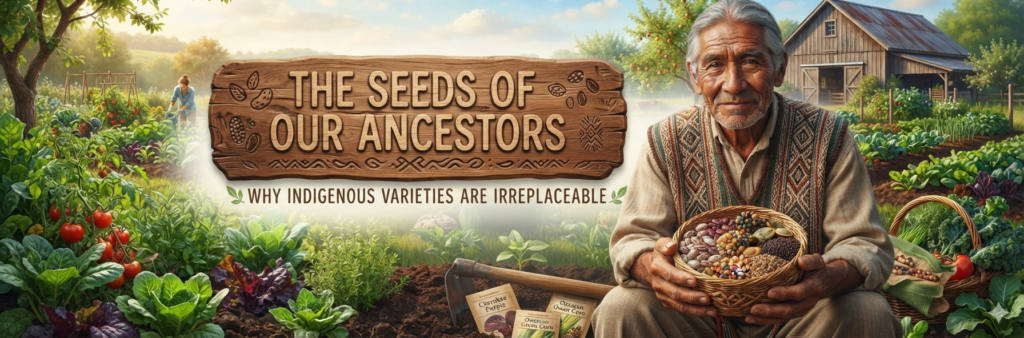
There is a quiet crisis unfolding in our fields — one that does not make headlines as often as drought or flood, but whose consequences are equally devastating. Over the past six decades, humanity has lost approximately 75% of its agricultural plant genetic diversity. Thousands of rice varieties, hundreds of wheat strains, and countless regional crops — cultivated and refined over generations by farmers who knew their land intimately — have disappeared. In their place, a narrow band of hybrid and genetically modified varieties now dominates global agriculture.
Understanding why this happened, and what we stand to lose — and regain — is essential for anyone committed to natural farming.
What Are Indigenous Seeds?
Indigenous seeds (also called desi seeds, native varieties, or landraces) are plant varieties that have been developed, selected, and refined over centuries through continuous cultivation in a specific region. They are the product of an unbroken conversation between farmers, land, and climate — varieties shaped by local rainfall patterns, soil types, pest pressures, and culinary traditions.
India’s agricultural heritage in this regard is extraordinary. Recorded history documents over 110,000 varieties of rice once cultivated across the subcontinent — varieties adapted to specific elevations, flood conditions, drought cycles, and taste preferences. Tamil Nadu alone had over 2,000 named rice varieties. Varieties like Kala Namak from Uttar Pradesh, Pokkali from the backwaters of Kerala, Sona Mokdo from the Eastern Ghats, and Navara from Kerala were not merely food crops — they were cultural and ecological keystones, deeply woven into ritual, medicine, and identity.
How Industrial Farming Destroyed Crop Diversity
The Green Revolution of the 1960s and 1970s brought high-yielding variety (HYV) seeds, synthetic fertilisers, and pesticides to Indian agriculture. The productivity gains were real and saved millions from starvation. But the cost — paid in biodiversity — was staggering.
HYV seeds were bred for maximum yield under ideal conditions: irrigated land, heavy fertiliser inputs, and pesticide protection. They were genetically uniform — every plant in a field was essentially identical. This uniformity allowed for mechanical harvesting and standardised processing, but it also made crops catastrophically vulnerable to new pest strains and diseases. The Irish potato famine of the 19th century, caused by reliance on a single potato variety, is the most famous example of what monoculture vulnerability looks like at scale.
In India, the shift to HYV seeds pushed indigenous varieties out of fields, out of memory, and often out of existence. Farmers who had grown fifteen or twenty varieties of rice — some for cooking, some for medicine, some for ritual use — found themselves growing one or two. The local knowledge that told them which variety to plant in the low-lying, flood-prone plot and which variety yielded in drought was no longer passed on because it was no longer needed.
Characteristics of Desi Seeds: Why They Are Superior for Natural Farming
Indigenous varieties are not “backward” — they are sophisticated. Their characteristics make them uniquely suited to natural farming systems:
Adaptability: Landraces are adapted to specific local conditions. Pokkali rice can tolerate high salinity and is grown in the brackish backwaters of Alappuzha, Kerala, where no modern variety survives. Jeerigeseame from Karnataka’s dry regions produces reliably in soils where rainfall is minimal and erratic.
Nutritional richness: Research by institutions including the MS Swaminathan Research Foundation and the Indian Institute of Rice Research has consistently found that traditional varieties contain higher levels of iron, zinc, protein, and fibre than their modern counterparts. Navara rice, used in Ayurvedic medicine, has documented anti-diabetic properties. Kala Namak rice contains significantly higher levels of vitamin B1 and protein than common market varieties.
Flavour and aroma: Basmati — arguably the world’s most famous rice — is itself an indigenous variety refined over centuries in the Indo-Gangetic plains. The complex aroma profile of traditional varieties reflects compounds produced through generations of co-evolution with specific soil microbial communities, which industrial farming systems cannot replicate.
Resilience without inputs: Because desi varieties were developed under natural conditions, without synthetic fertilisers or pesticides, they function well in low-input systems. Their root structures tend to be more expansive, their natural pest resistance mechanisms more developed.
Seed stability: Unlike hybrids, indigenous seeds breed true — meaning farmers can save seed from their best plants and sow it the following season without loss of quality. This is the foundation of seed sovereignty.
How to Identify and Source Indigenous Varieties
Finding authentic indigenous seeds requires some effort, but a growing network of seed custodians and organisations makes it increasingly accessible:
- Navdanya (founded by Dr. Vandana Shiva), based in Dehradun, operates one of India’s largest community seed banks and supplies indigenous seed varieties to farmers across the country.
- Deccan Development Society in Telangana maintains a collection of traditional dryland crop varieties and actively supports tribal women farmers in seed conservation.
- ICAR’s National Bureau of Plant Genetic Resources (NBPGR), Delhi, maintains a national seed repository of over 400,000 accessions — the largest in Asia — and can provide small samples for evaluation.
- Local agricultural universities and Krishi Vigyan Kendras (KVKs) are increasingly stocking indigenous varieties as part of state-level organic farming promotion initiatives.
- Farmer networks and seed fairs — organised by groups like the Organic Farming Association of India (OFAI) — are excellent sources of both seeds and the knowledge that accompanies them.
The Role of Traditional Seed Knowledge
Seeds, in Indian tradition, were never just agricultural inputs. They carried knowledge — of timing, of companion planting, of medicinal use, of ritual significance. When a desi seed is preserved, the knowledge embedded in its cultivation is also preserved.
In many adivasi communities across Jharkhand, Odisha, and Madhya Pradesh, seed selection, storage, and exchange are governed by community protocols that have maintained genetic diversity for centuries. Women, in many of these communities, are the primary seed custodians — a role that carries both practical and spiritual authority.
Reconnecting with indigenous seeds is not nostalgia. It is an investment in genetic diversity — nature’s insurance policy against an uncertain future.
Next week, we get practical with seeds — learning the techniques for selecting, drying, cleaning, and storing seeds so that the varieties we value are preserved and strengthened season after season.