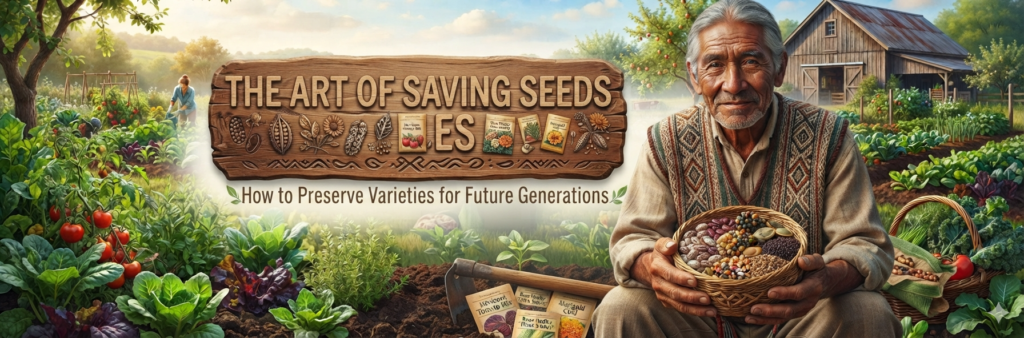
For most of human history, every farmer was also a seed keeper. At the end of each season, the best plants were selected, their seeds carefully harvested, cleaned, dried, and stored to carry the living potential of this year’s harvest into the next. This practice — ancient, simple, and profound — is what made agriculture possible. Without it, there would be no domesticated crops, no food security, and no inheritance of agricultural knowledge across generations.
Today, seed saving is experiencing a renaissance. As farmers and gardeners worldwide reclaim their agricultural independence, the skills of seed selection and storage are being relearned, refined, and shared. This week, we walk through the complete process — from selecting plants in the field to storing seeds through the summer heat.
How to Select Seeds for Saving
Seed saving begins not at harvest but at the start of the growing season, with the act of careful observation. The goal is to identify the individual plants that best represent the qualities you want to preserve and strengthen.
Select for vigour first: Look for plants that germinated earliest, grew strongly from the start, and remained healthy throughout the season — without exceptional inputs. These plants carry genetic traits for robust early establishment.
Select for adaptation: Favour plants that thrived under your specific conditions — your soil type, your typical rainfall, your local pest pressure. Over successive seasons of selection, you will be progressively adapting the variety to your farm, creating what is effectively your own locally adapted strain.
Select for quality: Choose plants whose fruits, grains, or pods best represent the variety’s ideal characteristics — size, colour, shape, aroma, and taste. For grain crops, select from panicles or ears that are well-filled and representative, not the largest outlier, which may not be reliably reproducible.
Select multiple plants: Never save seed from a single plant. For open-pollinated crops, collect seed from at least 15 to 20 individual plants to maintain genetic diversity within the variety. For cross-pollinating crops like maize, 50 or more plants are recommended.
Mark your selected plants: As soon as you identify the best plants early in the season, mark them with a coloured string or stake so they are not harvested or disturbed before seed maturity.
Allowing Seeds to Reach Full Maturity
Seeds saved for replanting must be allowed to reach full physiological maturity — a point beyond commercial harvest maturity. This is one of the most common mistakes made by new seed savers.
For cereals (rice, wheat, sorghum, millets): allow grains to dry on the plant as long as possible before threshing, until they are completely hard and the plant itself has dried down. The grain’s moisture content should be below 12% before storage.
For legumes (beans, cowpea, lentils): leave the pods on the plant until they rattle when shaken and have turned brown and papery. Shell the seeds and check that they are fully hard.
For cucurbits (cucumber, pumpkin, gourd): the fruit must be left on the vine well past the eating stage. Pumpkin seeds should be taken from fruits that have been stored for several weeks after harvest. The seeds extracted should be fully white and firm.
Drying, Cleaning, and Processing Seeds
Moisture is the enemy of seed viability. All seeds must be thoroughly dried before storage to prevent fungal growth and insect damage.
Drying: Spread seeds in a thin, single layer on a clean cloth, mat, or tray in a warm, well-ventilated, shaded area. Direct sun can damage seeds, so shade drying is strongly preferred. Stir or turn seeds daily. Drying typically takes 5 to 14 days depending on initial moisture content and ambient humidity. Seeds are adequately dry when they snap cleanly when bent (legumes) or cannot be dented with a fingernail (grains).
Cleaning and winnowing: After drying, remove chaff, plant debris, and damaged seeds. Traditional winnowing — pouring seeds from height in a gentle breeze, or using a flat winnowing basket — effectively separates light chaff from heavier seeds. For grain seeds, a fine mesh screen or sieve further removes small debris.
Selection after processing: Do a final visual sort, removing any discoloured, shrivelled, damaged, or abnormally small seeds. Only the best go into storage.
Traditional Storage Methods: What Our Grandmothers Knew
Traditional Indian communities developed highly effective seed storage methods using locally available materials, often achieving viability over many seasons without refrigeration or sealed containers.
Neem: Dried neem leaves (Azadirachta indica) are mixed with stored seeds as a natural repellent. Neem contains azadirachtin, which disrupts the life cycle of weevils, beetles, and moths. The traditional method involves layering seeds with dried neem leaves in the storage vessel. Neem leaf powder or dried neem twigs are also effective.
Ash: Wood ash, especially from hardwoods, creates an alkaline, inhospitable environment for insects and absorbs moisture. Seeds are mixed with ash at a ratio of roughly one part ash to ten parts seed, or layers of ash are placed at the bottom and top of the storage container. This method is widely used for pulse storage across rural India.
Clay pots (matkas): Unglazed clay pots regulate humidity through gentle evaporation from their walls. Seeds stored in sealed clay pots, often buried partially in cool earth, maintain better viability than those stored in plastic containers in hot climates. The traditional practice of sealing pot mouths with cow dung paste and then with cloth adds a final layer of pest exclusion.
Dried chilli and garlic: Many communities add whole dried red chillies or garlic cloves to grain and pulse storage as additional pest deterrents. Both have documented fumigant properties.
Cool, dark, dry storage: Whatever method is used, the fundamental principles remain constant: cool temperature, low humidity, darkness, and exclusion of pests. Above all, seeds must be fully dry before sealing into any container.
Community Seed Swaps: Multiplying Diversity Through Sharing
One of the most effective ways to maintain a diverse collection without the burden of individually maintaining every variety is through seed swaps — exchanges between farmers, gardeners, and community members.
Seed swaps create a distributed network of storage: even if one farmer’s collection is lost to flood or pest damage, the variety survives in neighbouring gardens. They also circulate varieties into new environments, revealing which perform best where, and keeping varieties in active cultivation — which is essential, because seeds stored without occasional replanting eventually lose viability.
Seed melas (seed fairs) organised by groups like OFAI, Navdanya, and various state organic farming missions have become joyful celebrations of agricultural diversity, where farmers bring their rarest varieties to share and exchange alongside food, stories, and traditional knowledge. The annual seed festivals organised in Deccan villages and adivasi communities across the Eastern Ghats are living museums of India’s agricultural heritage.
Maintaining Genetic Diversity Through Seed Saving
Seed saving, practised thoughtfully, does not merely preserve varieties — it slowly improves them. Each season of careful selection gradually accumulates the genes most suited to your specific conditions. Over ten to twenty generations of selection, a landrace sown on your farm becomes, in a meaningful sense, your variety — carrying the imprint of your soil, your climate, and your eye.
This is why the practice of seed saving is inseparable from the practice of close, attentive farming. The best seed savers are also the most careful observers — farmers who know their land intimately and understand what strength and health look like in a plant.
Next week, we scale up from individual seed saving to organised seed banks — exploring how community and national seed libraries protect agricultural heritage and how you can participate in or even start a local seed bank.